
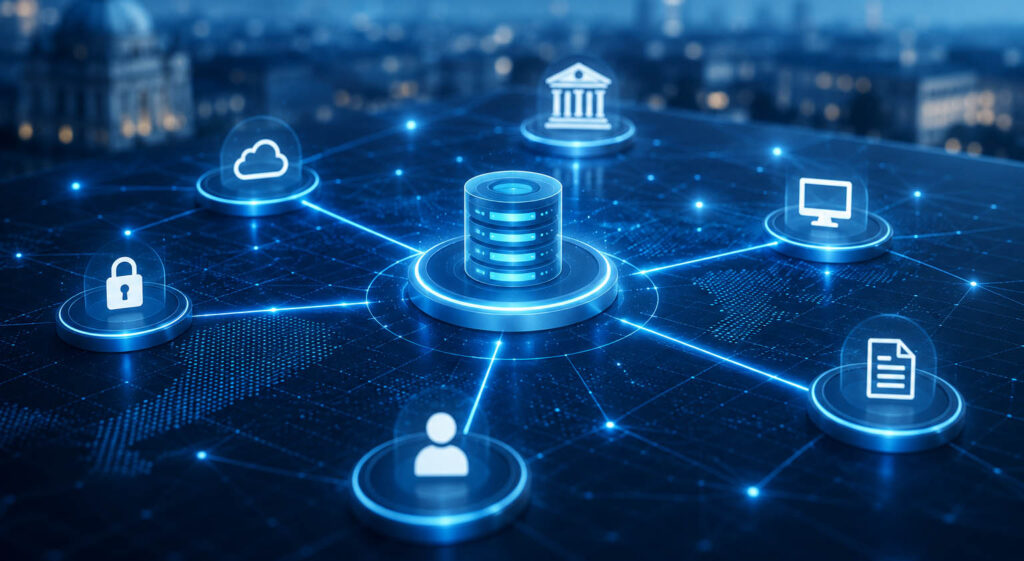
Integrated solutions and interoperability
Build a unified digital ecosystem in which data flows quickly, securely and automatically between the institution’s systems, national platforms and third-party services.
Integrated digital architecture and interoperability between public systems
Real digital transformation of public administration depends on systems that communicate efficiently with each other. Integrated solutions and interoperability create a unified software ecosystem in which the institution’s applications are natively connected to each other and to the main national platforms and third-party services.
By automating data exchange and connecting systems in a coherent digital workflow, information flows quickly and securely, with no duplicate data and no unnecessary administrative steps.
An open, scalable and connected digital ecosystem
We build digital architectures in which applications, platforms and services communicate efficiently in a unified, coherent ecosystem. Data goes where it is needed, and processes become simpler, faster and easier to manage.
Through interoperability, institutions can connect their existing systems, remove redundant processes and make better use of the information they hold. Their digital infrastructure becomes more flexible and easier to extend as new technologies and services appear.
Integration with national and third-party platforms
National platforms
- ROeID / eIDAS: Secure authentication of citizens and users.
- ghișeul.ro: Integration for processing and managing electronic payments.
- ANAF (PatrimVen): Reporting and tax data exchange with the National Agency for Fiscal Administration, to simplify administrative processes.
- STS: Integration for qualified electronic signature services (Special Telecommunications Service).
- ONRC: Verification and retrieval of company data from the National Trade Register Office.
- just.ro: Access to and integration with court data and information relevant to the institution’s processes.
Commercial and third-party solutions
- Online payment processors: Payment services integrated into the institution’s digital workflows.
- Payment kiosks and networks for local taxes: Connection with services such as SelfPay and banking networks.
- Electronic signature platforms: Integration with cloud-based or token-based electronic signature solutions.
- ERP and financial management systems: Automatic data exchange with the organisation’s financial and management systems.
- Third-party public administration applications: Integration with specialised solutions for taxes, documents, records and other administrative processes.
Administrarea proceselor pe baza conceptului de dosar, cu urmărirea completă a activităților.
Organizarea activităților, rolurilor și grupurilor de lucru pentru fiecare dosar.
Acces rapid la documente prin Windows Explorer și integrare cu Microsoft Office și Outlook.
Evidența cetățenilor, companiilor și instituțiilor, împreună cu istoricul interacțiunilor și dosarelor.
Automatizarea circuitelor documentelor pe baza unor fluxuri configurabile.
Identificarea rapidă a documentelor și dosarelor prin filtre și căutări avansate.
Suport pentru semnare electronică, în bloc, cloud, token, STS și semnătură olografă.
Configurarea formularelor și câmpurilor în funcție de tipul documentului sau procesului.
We are here to discuss the right solutions for your institution
Benefits
No more gaps between the institution's applications
Connecting existing applications in a unified digital ecosystem lets information flow between departments and systems.
Less duplicate data and fewer operational errors
Data is captured and synchronised automatically, reducing manual entry and the risk of duplicate or incorrect information.
Faster information processing
Automatic data exchange speeds up administrative processes and reduces the time needed to access and verify information.
Full integration with the national e-Government ecosystem
The institution's systems can interact with national digital platforms and services, simplifying access to data and public services.
Flexibility to use third-party solutions
The open architecture allows integration with commercial applications, specialised platforms and external services.
Better transparency and operational control
Interconnected data flows and processes give a clearer view of activities and enable more efficient operational control.
Automated data exchange between systems
Information can be transferred automatically between applications, reducing manual work and simplifying repetitive processes.
Scalability for future growth
The interoperable architecture lets you add new applications, services and integrations as the institution's needs evolve.
Connect systems. Simplify processes. Build digital government.
Discover how integrated solutions and interoperability can turn your institution's digital infrastructure into a unified, connected and future-ready ecosystem.

